
News
Your location:Home - News - Research Payoffs - Detail
To conduct comprehensive testing of relay protection devices, professional and efficient testing equipment and systems are required. The test instruments currently available on the market generally suffer from the following shortcomings:
1)Different relay protection test instruments require the establishment of their own proprietary test templates. The data formats and test templates across various test instruments are not mutually compatible, meaning each instrument can only recognize and use its own specific formats. This incompatibility significantly reduces the efficiency of creating and using test templates, making it a time-consuming and labor-intensive process, especially when facing testing tasks that are urgent and heavy.
2)Single Method for Generating Test Templates
Test templates can only be manually generated one by one, based on the specific project under test.
3)Manual or semi-automatic testing methods involve extensive human intervention and a low degree of automation. The process requires personnel to first modify the settings of the relay protection device, then apply the analog or digital signals that assess the new settings, and finally, manually determine whether the test result is pass or fail based on the action indicators of the digital signals received by the test equipment. This leads to low testing efficiency and is prone to errors.
4)Data processing is complex and difficult.
In the later stages of testing, processing large volumes of raw data without the aid of automated tools is like drowning in a sea of data.
Therefore, a test system that possesses capabilities such as automatically generating test templates, enabling cross-platform use of a single template, performing coordinated and sequential automated operations for modifying settings and applying stimuli, automatically judging action results/performance indicators, and automatically filtering and exporting test data is truly invaluable .
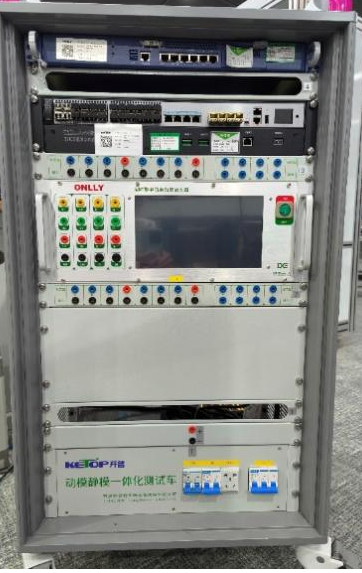
To address challenges in static mode testing, such as the high difficulty in test case compilation, poor adaptability of test cases to different settings and configurable plugins, incompatibility of the same test case across different test instruments, difficulties in coupling batch setting modifications with test cases, low automation levels in the testing process, incomplete test result collection, challenges in conducting normative testing of action information, and issues with fault waveform processing and batch playback, KETOP developed an intelligent generative static mode testing platform that effectively resolves these challenges .
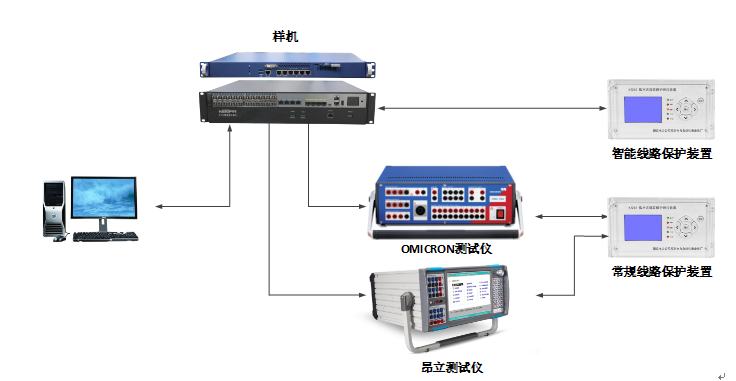
The overall architecture of an intelligent generative automatic detection system primarily consists of three key links: test stimulus application, station control level management, and test result processing. In the test stimulus application link, a user-friendly and efficient testing interface is utilized for editing test items to form test scripts, which are described using XML. The same test script can be executed by different test instruments. When connecting to a test instrument, the corresponding interface module (DLL dynamic-link library) specific to that instrument is employed to translate the test script into test commands supported by the instrument. The test instrument then executes the operations outlined in the script and returns the test results. The station control level is responsible for managing the overall testing process and coordination, while the test result processing link handles the analysis and output of the data obtained.
Station-Level Control: This involves embedding station-level operations into the test script, such as reading telemetering data, reading versions, switching zones, modifying settings, and arming/disarming plates. Additionally, the station-level sub-station should possess the functionality to perform batch operations on multiple devices, automatically synchronize protection fault recording files, and conduct information specification testing.
Test Result Processing: Upon completion of each test item, the resulting documents are utilized to form the complete test records, ultimately generating a test report in a predetermined format.
The successful development of the RTbasic intelligent generative static mode testing system for relay protection provides a new solution for the type testing of power system relay protection products. It also offers fresh perspectives and methods for field acceptance by power users and R&D testing by manufacturing enterprises. With its high cost-effectiveness, user-friendly operation, and low barrier to entry, RTbasic can effectively promote the application of relay protection devices in smart substations, enhance the testing and application level of relay protection products, and thereby lay a solid foundation for the safe, stable, and economical operation of China's power system.
In September 2023, this achievement was appraised by the China Machinery Industry Federation and the Henan Electrical Appliance Industry Association as having reached the internationally advanced level.
页面版权所有:许昌开普检测研究院股份有限公司 豫ICP备15015526号-1 豫公网安备 41100202000037号